 Rob

A printable habit tracker gives you somewhere to record whether a clearly defined action happened. The useful part is the definition. “Be more organised” is difficult to mark honestly; “put tomorrow’s papers in my bag before bed” is an action you can recognise. Start with one or two actions before filling a page with ambitions.
If reading is the action you want to track, use the printable reading log for book titles and session notes. Keep the habit grid for whether the action happened, so the two records answer different questions.
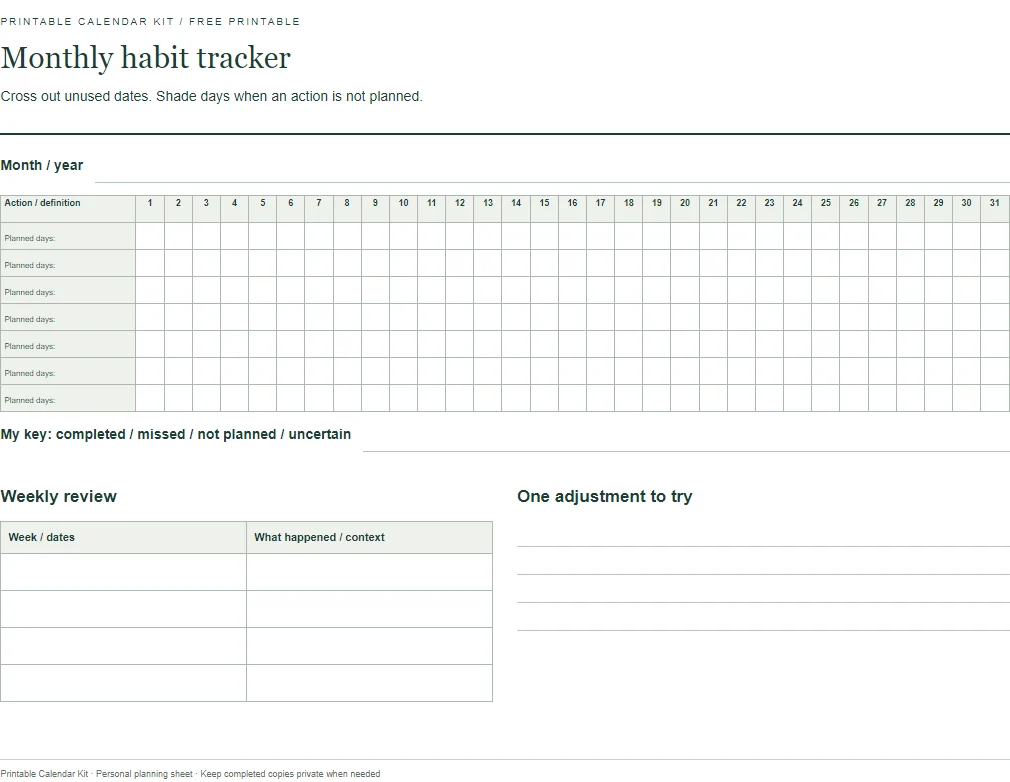
Open the monthly habit tracker and weekly review. The printable has a 31-day grid, space to define your marks and a short review section. It prints on A4 or Letter. Cross out dates that do not exist in the month rather than treating them as missed days.
Choose an action that fits in one line
Write the action as something you do, with enough detail to decide whether it happened. “Read” might mean opening a book, reading a chapter or spending ten minutes with a novel. None is automatically the right definition. Choose the version you actually want to record and write it beneath the habit name, especially if the short label could mean several things.
A useful example is “read one page after making evening tea”. It names an action and an occasion. On a busy evening, one page still counts because it matches the definition. Reading twenty pages can be welcome without changing what the basic tick means. Avoid quietly raising the threshold halfway through the month, then judging earlier marks by a different standard.
Some activities happen on selected days. If you intend to practise a language on Monday, Wednesday and Friday, shade the other days before starting. A daily grid does not require a daily commitment. This distinction matters at review time: you are comparing completed occasions with planned occasions, not automatically dividing every result by thirty-one.
Use a small key with one meaning per mark
Choose marks you can distinguish when the page is photocopied or viewed in ordinary light. For example, a tick can mean completed as defined, a dash can mean planned but not completed, and a shaded cell can mean not planned. A question mark can mean that you cannot remember. Do not turn an uncertain memory into a confident tick merely to make the row look complete.
A blank cell is ambiguous unless you define it. It could mean you forgot to record, skipped the action or had not scheduled it. If blank means “not yet recorded”, return to the page briefly at a regular time and add the appropriate mark. You can also keep blanks deliberately and make a note that they are unknown; just avoid treating unknown days as reliable evidence.
Colour is optional. If you use it, add a symbol as well so the information survives black-and-white printing. You do not need separate shades for every mood or level of effort. More categories create more decisions each time you record. Add a new category only when the distinction will help answer a real question.
A completed week, read carefully
A seven-day record with five completed days
| Day | Mark | Meaning |
|---|---|---|
| Monday | ✓ | Completed |
| Tuesday | ✓ | Completed |
| Wednesday | – | Not completed; away |
| Thursday | ✓ | Completed |
| Friday | ✓ | Completed |
| Saturday | ? | Unknown; recorded two days late |
| Sunday | ✓ | Completed |
Imagine the habit is “read at least one page after evening tea”, planned for all seven days. The row shows ticks on Monday, Tuesday, Thursday, Friday and Sunday, a dash on Wednesday and a question mark on Saturday. You know the action happened on five days, did not happen on one and is uncertain on one. Saying “five recorded completions out of seven planned occasions” preserves that distinction.
The notes say Wednesday involved an evening away from home and Saturday was recorded two days late. These notes suggest two different adjustments. You might take a book when away from home, and you might place the tracker beside the tea things so recording happens sooner. The grid alone cannot tell you which adjustment is useful; the brief context makes the marks more informative.
Now consider a second row for clearing a desk on working days. There are four ticks and one dash, with Saturday and Sunday shaded. This row has five planned occasions, not seven. Comparing its raw number of ticks with the reading row would be misleading because the schedules differ. Review each action against its own definition and intended frequency.
Make the weekly review short and specific
The review section asks what happened, what got in the way and what you will change. Use observations rather than broad judgments about yourself. “The papers were still downstairs when I packed my bag” identifies a practical obstacle. “I am terrible at routines” does not tell you where to put the papers or which part of the evening needs adjusting.
Choose one adjustment for the next week. You could reduce the action, move the tracker, change the occasion or decide that the activity belongs on fewer days. Write the new definition if the action changes. A line across the grid or a dated note helps you remember that marks before and after the change describe different arrangements.
You can also decide to stop tracking an action. If the page is no longer answering a useful question, removing a row is sensible. The purpose is to support a choice you care about. Completing the tracker itself does not have to become another permanent obligation.
Handle missed days without rewriting the record
When an action is missed, mark it according to your key and resume at the next suitable occasion. There is no need to erase the row or recreate the entire month. A gap can show that a particular day is difficult, or it can simply show that other plans took priority. The record does not establish why something happened unless you add reliable context.
Do not invent a catch-up rule after the fact. If the action is “read one page each evening”, reading several pages on Sunday does not turn Thursday into a completed evening. You may still value the extra reading. Record it as an additional note while keeping the original definition intact.
Similarly, avoid filling a week from memory unless you can distinguish what you remember from what you are assuming. Mark uncertain cells with the question mark from your key. An incomplete but honest record is easier to learn from than a perfect-looking page reconstructed to fit expectations.
Set up the printable for your month
Write the month and year, name each action and add the intended days. Cross out day thirty-one in a thirty-day month, and cross out the unused end dates in February. The sheet is deliberately undated, so it does not decide the length of the month for you. A dated monthly calendar can sit beside it when matching dates to weekdays helps.
Print at a comfortable size and check the last column in the preview. The grid is landscape so the date cells have room for simple marks. Select the matching paper size in the print dialog. If your printer clips the border, use its fit setting and inspect the preview again before printing several copies.
Keep the tracker somewhere connected to the action, provided it does not expose information you want private. A reading tracker beside a book may be convenient; a personal routine tracker may belong inside a notebook. This is a paper record: anything you write remains on your copy, and you do not need to submit the completed sheet to use it.
Questions about habit tracking
How many habits should I track?
Begin with the smallest set that will help you make a decision. One well-defined action can be enough. Add another row when recording feels manageable and the extra information has a purpose. A full page is not evidence that a tracker is working better.
Does the tracker tell me when a habit is established?
No. It records the marks you enter. It does not measure automaticity or prove that an action will continue without reminders. Avoid assigning a universal number of days to every activity. You can decide whether to keep recording based on whether the information remains useful.
What if I prefer a weekly sheet?
Use only the seven columns for your chosen dates and ignore the rest, or write the action in the notes area of the weekly planner. The same definition and marking key still apply. Choose the layout you are likely to consult when the action happens.