 Rob
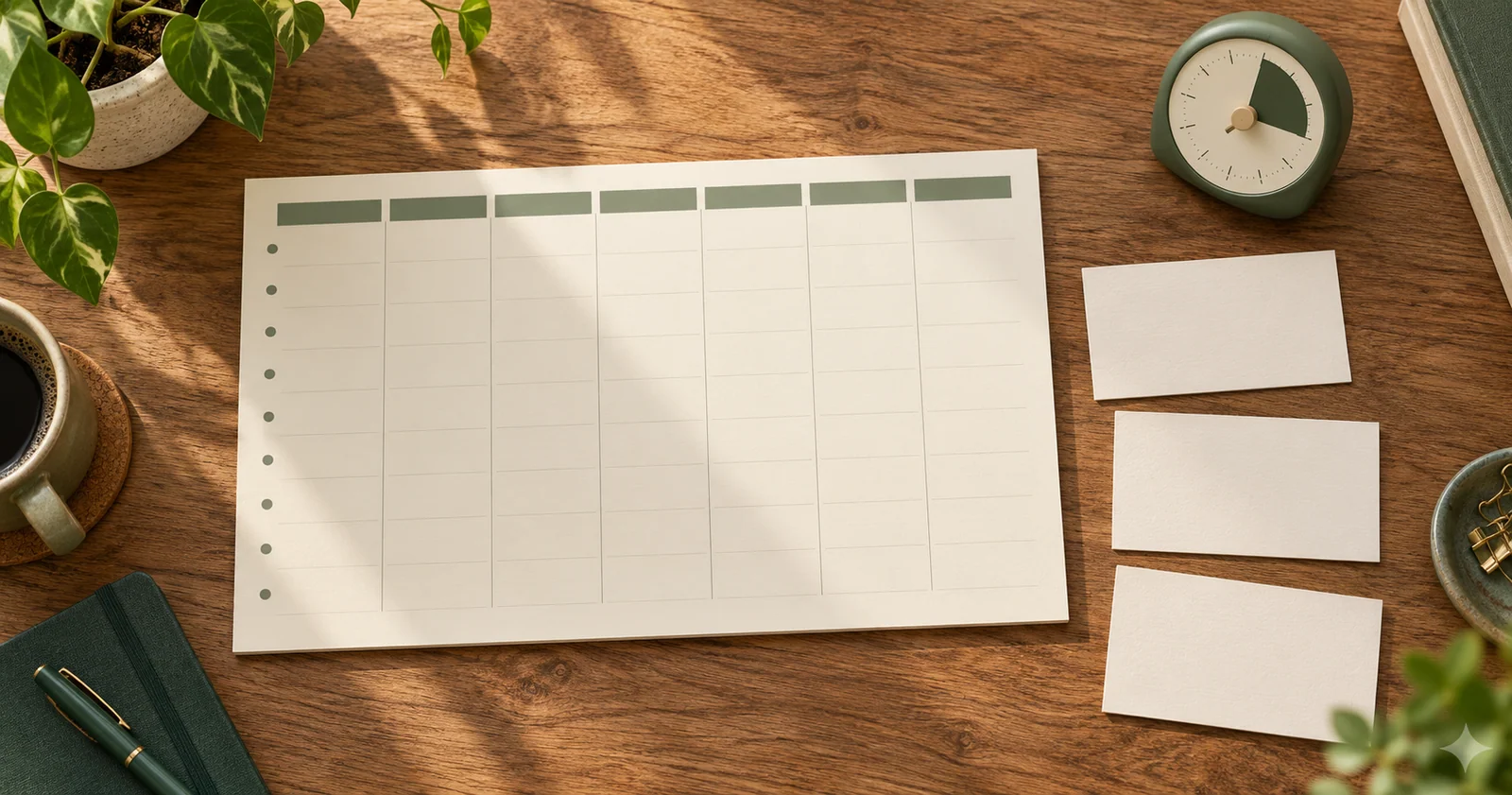
Planning your week means deciding what can fit around commitments you already have. A useful weekly plan includes a few chosen outcomes, the next actions that support them and some room for changes. It does not require you to predict every hour or clear every task you have ever written down.
The twenty-minute routine below is a suggested time limit for making those decisions. It is not a claim that every week can be fully organised in twenty minutes. If your week contains an unresolved booking or a complicated project, identify the next decision during the review and give that work its own time.
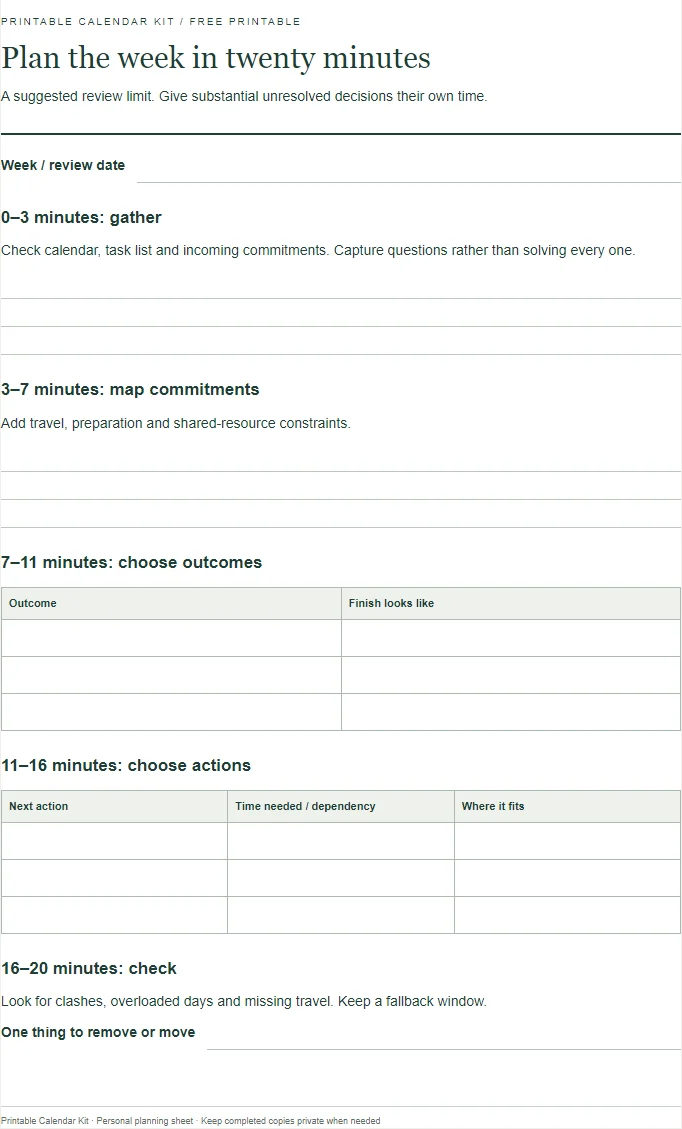
Use the weekly planner alongside the printable twenty-minute review sheet. The example follows a fictional person named Jamie, who is balancing ordinary work, appointments and a small home project.
Minutes 0–3: gather the information that changes the week
The twenty-minute weekly planning sequence
| Minutes | Action | Leave with |
|---|---|---|
| 0–3 | Gather dates and loose ends | Reliable inputs |
| 3–7 | Map commitments and preparation | Occupied windows visible |
| 7–11 | Choose two or three outcomes | A short current selection |
| 11–16 | Choose actions that fit | Tasks with usable windows |
| 16–20 | Check capacity and fallback | A plan that allows changes |
Put your calendar, current task list and relevant notes in reach. Check the places where new commitments actually arrive: perhaps a shared calendar, school messages, work emails or a paper letter tray. You are looking for dates, decisions and actions that affect the coming week, not processing every message during the review.
Jamie finds a Wednesday afternoon appointment, a parcel collection deadline and a note about returning borrowed tools. The calendar also shows a Thursday evening commitment and a visitor on Saturday. These facts matter before choosing a list of additional projects. If Jamie started with an ambitious task list, the later discovery of those commitments would force the whole plan to change.
Capture anything unclear as a question. “Confirm whether the appointment is in person” belongs on the list before assuming there is no travel. Write who can answer and the next action for finding out. An unresolved detail can be managed openly instead of becoming an invisible risk in the schedule.
Minutes 3–7: map fixed commitments and preparation
Write the commitments that cannot easily move, then add travel, setup or preparation where needed. A booking is more than its printed start time. If it needs a document, an item to bring or a journey, place those supporting actions early enough to happen.
Jamie’s Wednesday appointment runs from 14:00 to 14:45. The journey takes about twenty minutes each way, so Jamie reserves 13:30–15:15, including an arrival margin and a little room on the return. Tuesday’s plan includes finding the relevant paperwork. This prevents “attend appointment” from appearing as a small isolated box while its preparation remains unscheduled.
Mark constraints as well as appointments. If another person needs the household car on Friday, that affects which errands fit. If a home delivery needs someone present, it may still allow desk work but rule out leaving the house. Short notes such as “car unavailable” or “stay home for delivery” make those limits visible.
Minutes 7–11: choose two or three useful outcomes
Look at the remaining time before choosing outcomes. An outcome describes what you want to have changed by the end of the week. “The spare-room desk is usable” is clearer than “be productive at home”. “Send the revised project outline” has a visible finish; “work on project” does not.
For this example, Jamie chooses to clear the desk, return the borrowed tools and send a document needed for next week. There are other attractive possibilities, including reorganising the entire room, but those do not fit equally well. Keeping them on a separate ideas list preserves them without pretending they are this week’s commitments.
Check whether any outcome depends on another person. Sending the document may require a colleague’s answer first. Put the request early in the week and identify what you can do while waiting. If the answer does not arrive, the plan needs a fallback, such as preparing the parts that do not depend on it or agreeing a revised deadline.
Minutes 11–16: turn outcomes into actions that fit
Break each outcome into the next few actions. Clearing a desk might mean moving unrelated items to a sorting box, filing a specific pile and reconnecting a lamp. You do not need a detailed plan for every possible later improvement. Include enough steps to start and enough information to recognise the intended finish.
Estimate each action using experience where possible. If sorting a similar pile took forty minutes last time, do not casually label the new one a ten-minute task. If the size is unknown, schedule an inspection step: “spend fifteen minutes sorting the top layer and estimate the remainder”. Learning the size of the work is a legitimate result.
Jamie puts the document request on Monday morning, a forty-minute desk session on Tuesday evening and the tool return beside an existing Thursday errand. The parcel collection fits into Friday’s journey, provided the collection location is open at that time. Jamie checks the actual opening information before relying on the combination.
Use task lists for work that can move and time blocks for work that needs protection. Not every five-minute action needs a separate calendar event. A short administration block can contain several compatible actions, provided it does not disguise more work than the time allows.
Minutes 16–20: check capacity and leave a fallback
Read the plan as if you had to carry it out now. Are two commitments overlapping? Does an errand require a journey you have not counted? Have you filled an evening after an already demanding day? These checks are easier while the plan is still small.
Jamie notices that Thursday now contains a workday, an errand, the tool return and an evening commitment. The tool return can move to Friday without affecting anyone, so Jamie asks the owner and updates the plan. This is a useful planning decision: it removes pressure before the week starts.
Leave at least some unassigned time in the parts of the week where you have discretion. The amount depends on your circumstances; there is no universal percentage in this worksheet. If a week has very little flexible capacity, choose fewer outcomes and make that limitation explicit. Empty space is only a buffer if you have not already promised it to several tasks.
The worked week at a glance
Monday contains the request for missing document information and a check of the parcel collection details. Tuesday has the desk session and appointment-paperwork preparation. Wednesday protects the appointment and travel. Thursday keeps the existing evening commitment and one necessary errand. Friday holds the document completion, parcel collection and agreed tool return. Saturday has the visitor arrangement; Sunday remains mostly open, with a brief look ahead.
That description is intentionally uneven. A weekly plan does not have to give every day the same number of tasks. Wednesday’s appointment reduces its capacity, while Friday has compatible actions that fit its actual arrangements. The meaningful comparison is between each day’s obligations and available time, not between the visual lengths of its lists.
The optional room reorganisation remains outside the main plan. If Jamie has unexpected time and wants to use it, the next small action is available. If the week changes, nothing needs to be labelled a failure because an optional idea was never promoted into a commitment.
Make a small midweek adjustment
A brief check during the week helps keep the plan current. Review what changed, what is blocked and what no longer needs doing. You do not need to repeat the full twenty-minute routine. Focus on decisions that affect the remaining days.
If the colleague’s answer arrives late, Jamie may move the document completion or narrow the planned desk work. If the visitor cancels, Saturday gains capacity, but that does not require filling it. New free time can remain free. A useful plan supports an intentional choice rather than automatically absorbing every available minute.
When moving an action, cross out or mark the original clearly and write the new location. Avoid leaving the same task active on three different days. If a task keeps moving, inspect its wording, importance and dependencies instead of repeatedly giving it another arbitrary date.
Adapt the routine to different weeks
For shift work, begin with the confirmed shifts and travel, then plan within the remaining blocks. Your review day does not need to be Sunday. It can happen when the next rota becomes available. Keep uncertain shifts visibly tentative until confirmed.
For a shared household, agree the commitments that affect other people before assigning individual tasks. A person’s name beside an action should reflect an agreement, not a silent assumption. Check access to shared transport, rooms or equipment when those resources affect the plan.
For a week with unpredictable demands, use fewer exact task times and a small list grouped by the kind of opportunity needed. A ten-minute phone task, a quiet desk task and an errand are different options. Knowing which option fits a newly available window can be more useful than repeatedly redrawing a rigid timetable.
Questions about weekly planning
What if the review takes longer than twenty minutes?
Notice where the time goes. Finding scattered information may suggest a simpler capture system. Solving a project problem may need a separate work session. End the review with the next few decisions clear, and schedule any substantial unresolved work rather than stretching the review indefinitely.
Should I carry over every unfinished task?
No. Reconsider it. Some tasks still matter, some are waiting for information and some no longer deserve time. Move only the actions you choose to keep. A weekly review is a chance to update your commitments, not a rule that preserves every old entry forever.
Do I need daily pages too?
Only if they solve a practical problem. A daily page can help when appointments and actions need more detail, but a clear weekly sheet may be enough. Try the weekly routine first and add a daily page when you repeatedly need space the weekly view cannot provide.
How should two people share a weekly plan?
Agree which calendar holds shared commitments and which lists remain personal. Record an owner for each shared action and confirm changes that affect the other person’s time. A visible entry is not proof that someone has seen or accepted it. During the review, check transport, preparation and handoffs together, then leave individual task lists as detailed as each person needs.