 Rob

New year planning becomes practical when an annual intention leads to something you can do in an ordinary week. “Make better use of the garden” might be a meaningful ambition, but it does not tell you what to do on Saturday morning. A plan connects that ambition to a defined result, a sequence of milestones and the next action you can take.
This guide uses a fictional project: turning an unused corner of a home into a reading space. The example is deliberately modest so the planning decisions remain visible. Use the printable yearly-to-weekly planning pack to work through your own project, then place actual commitments on the yearly calendar and your weekly pages.
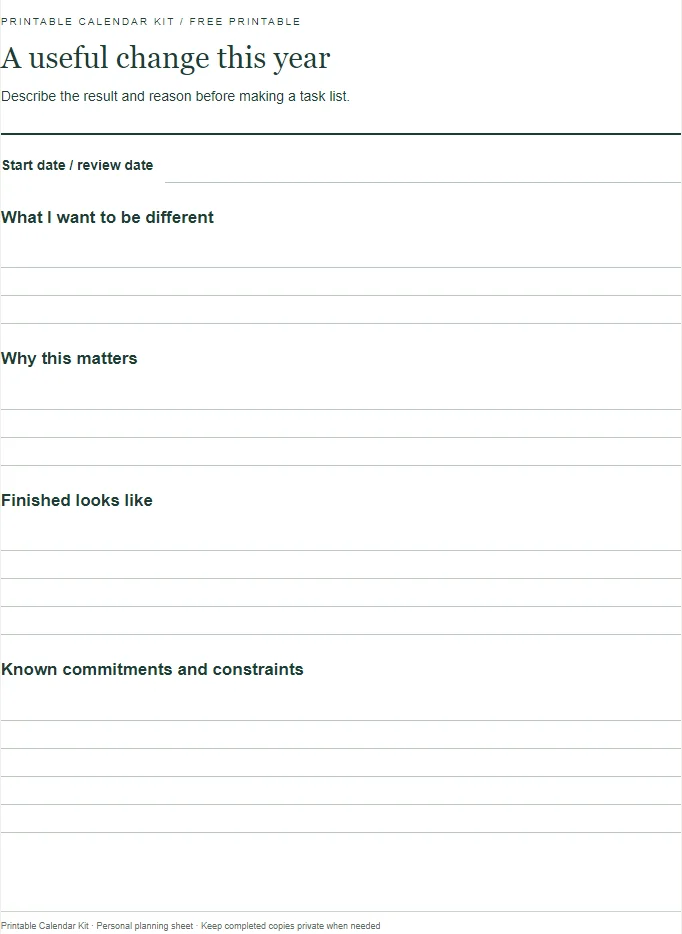
Begin with what you want to be different
Write the desired change in ordinary language. For the example, Rowan wants “a comfortable, usable reading corner with space for current books”. That describes a result without prematurely choosing every item that might belong there. “Buy a chair” is only one possible action toward the result, and it could be unnecessary if an existing chair works.
Add a reason that matters to you. Rowan’s reason is having a place to sit with a book without clearing the dining table first. That reason will help judge later choices. A decorative improvement that makes the corner harder to use would not serve the original purpose, even if it looks attractive in a photograph.
Define what would count as finished. Rowan chooses three conditions: the floor area is clear, a suitable existing seat and light are in place, and current books have an accessible home. The project does not require redecorating the room or replacing every piece of furniture. A visible finish protects the plan from gradually expanding into several different projects.
Take an honest look at the year ahead
Before dividing the goal into months, mark major commitments already known. Travel, busy work periods, family arrangements and other projects affect the capacity available. The yearly overview should reveal constraints, not create a promise to use every month equally.
Rowan knows January is busy, February has two free weekends and March includes visitors. That suggests a different plan from one that assumes twelve identical months. January can hold a short inspection and decision session. February can hold the main practical work. March can hold a review of whether the space actually works.
Keep uncertain commitments labelled as uncertain. A possible trip should not quietly become a confirmed absence, but it should remain visible if it could affect the project. You can choose a decision date: “confirm spring travel by the end of February”. Planning with uncertainty means naming it and deciding when to revisit it.
Choose one quarter-sized result
A year is often too long for a detailed action list. Choose a nearer milestone that would represent useful progress. A calendar quarter is one possible planning window, but the project may need a shorter or longer period. Use the quarter because it helps organise decisions, not because every goal must fit a ninety-day formula.
For Rowan, the first-quarter result is “reading corner set up and tried for several ordinary evenings”. The trial matters. A space that has been arranged but never used has not yet answered the practical question behind the project. Including a trial also leaves room to discover that the lamp or book position needs changing.
Other quarters do not need detailed tasks yet. Rowan can write “decide whether any further changes are useful” for later in the year. This avoids inventing nine months of work simply to fill the template. If the goal is achieved early, the remaining space can remain blank or support a different chosen project.
Divide the result into milestones with evidence
From annual aim to a first-quarter plan
| Milestone | Owner | Chosen review date | Next action / dependency |
|---|---|---|---|
| Corner measured, contents reviewed, layout chosen | Rowan | 31 January | Measure the wall and check the existing chair |
| Unwanted items dealt with and furniture placed | Rowan; agree any moving help first | 28 February | Arrange the layout after measurements and keep/relocate decisions |
| Space tried; practical adjustments decided | Rowan | 31 March | Use the corner on ordinary evenings, then review light and book placement |
These are fictional review dates chosen for the example’s January–March sequence, not deadlines for a real household. Shared help must be agreed before Rowan relies on it.
A milestone should describe a completed state you can recognise. Rowan’s first milestone is “corner measured, contents reviewed and layout chosen”. The second is “unwanted items dealt with and furniture placed”. The third is “space used and practical adjustments decided”. Each milestone produces information needed by the next stage.
Notice the dependency. Moving furniture before checking dimensions may create avoidable work. Choosing storage before reviewing the books may produce something unsuitable. Put decisions that shape later tasks earlier in the sequence. A planning sheet is useful when it prevents you from treating every task as equally ready to start.
Attach a review date to each milestone rather than assuming that writing it down guarantees completion. At the review, compare the actual state with the intended finish. If the milestone is incomplete, identify the remaining action and decide whether the later dates still make sense.
Translate the first milestone into next actions
For “measure and choose the layout”, Rowan writes three actions: measure the available corner, list the items currently stored there and try a simple arrangement with existing furniture. These are actions that can happen without first solving the whole year. The first one needs a tape measure and a short uninterrupted period.
A vague action such as “research reading corners” could expand indefinitely. If research is necessary, give it a question and a finish. “Check whether the existing chair fits the measured space” is bounded. “Compare three suitable lamp positions using the current light” is also bounded. The plan should make it easier to stop once the question is answered.
Write dependencies beside actions. If moving an item requires another person’s help, contact them before placing the move in a particular afternoon. If you need information from a supplier or property owner, the next action is obtaining that information, not assuming the answer and scheduling dependent work.
Put a small amount of work into the week
Look at a real week before assigning the actions. Rowan has a free forty-minute window on Saturday morning. Measuring and listing the current contents fit that window; reorganising the whole corner probably does not. The weekly plan includes those first actions and leaves the later work on the project sheet.
At the end of the session, record the actual result. Suppose measuring takes ten minutes and reviewing the contents takes twenty-five. The remaining five minutes can be used to write the next action. There is no need to start a large furniture move just because a few minutes remain in the block.
Use the result to improve the next estimate. If the contents review reveals several boxes of unsorted papers, the project is larger than expected. Rowan can narrow the reading-space project by relocating those boxes temporarily to an appropriate place, or expand the scope and change the dates. Either choice should be explicit.
Track evidence of progress, not only effort
Time spent can be informative, but it is not the same as a changed result. “Worked for an hour” does not show whether the layout decision is complete. Record the concrete output: dimensions noted, five items returned to their homes, or one arrangement tried.
For a goal based on repeated activity rather than a finished project, choose a suitable record. If the intention is to read regularly, a habit tracker can record the agreed action. A project plan and an activity tracker answer different questions. Do not make a milestone chart carry a daily record it was not designed for.
Keep the evidence light enough to maintain. A sentence after each work session may be enough. Photographs can be useful for a physical project if you want them, but they are optional. The record should help you decide what comes next, not create a second project about documenting the first.
Review the plan when circumstances change
At each review, ask whether the desired result still matters, what has changed and what the next useful step is. A goal chosen in January is not automatically the right priority in June. Changing circumstances can justify changing the plan without pretending the earlier decision was dishonest.
Suppose Rowan starts working from home more often and the same corner becomes needed for a desk. The original reading-space goal now competes with another use. The appropriate response is to reconsider the space, not force both plans into the same square metres because the yearly worksheet contains a commitment.
If the goal remains worthwhile but progress is slow, identify the constraint. Lack of time, an unclear next action and a dependency on another person require different responses. Reducing scope can address limited time. Clarifying the action can address uncertainty. A conversation can address a dependency. Copying the same goal into a fresh notebook does not by itself resolve any of them.
Keep later planning deliberately less detailed
Detail is most useful close to action. You can know the broad result for the year while leaving later steps open until earlier decisions are made. Rowan does not need to choose storage accessories before measuring the corner. The plan can say “decide after the trial” and still be complete enough to guide current work.
At the end of a quarter, use what happened to choose the next quarter’s focus. If the project is finished and useful, record that and stop expanding it. If one small adjustment would improve it, plan that adjustment. If the project did not serve its purpose, decide whether to change direction or stop.
This approach also works for a collection of small projects. Keep an annual list of possibilities, choose only a manageable subset for the current period and make the selection again later. The annual list is a menu until you deliberately commit capacity to an item.
Use the printable planning pack
The first sheet holds the annual intention, reason and finish conditions. The second connects the current quarter to milestones and review dates. The third turns the nearest milestone into weekly actions, dependencies and evidence of completion. Print only the pages you need on A4 or Letter.
Place the annual sheet somewhere you can find it during reviews, rather than carrying it on every daily page. Keep the weekly actions in your active planner. This gives the long view a reference role while allowing the everyday page to stay focused on current decisions.
Questions about new year planning
Do I have to begin in January?
No. Write your own start and review dates. The year can provide a convenient overview, but a useful project does not need to wait for a calendar boundary. Begin with the next action that fits your current circumstances.
How many annual goals should I choose?
Choose a number you can support with real time and attention. Compare the proposed work with existing commitments before adding another goal. One completed, useful project can be more valuable than a long list that never reaches a clear next action.
What if the first quarter goes badly?
Review the evidence and revise the remaining plan. Keep useful learning, remove assumptions that proved wrong and choose the next achievable milestone. You do not need to recreate the original timetable to make the rest of the year worthwhile.
What should I preserve for next year?
Keep the original goal, important revisions and the actual finish dates. Together they explain how the year developed more clearly than a final list of ticks. For the reading-corner example, note which furniture was reused, which measurement changed the layout and how many sessions preparation required. Those details can inform a later room project without assuming that every project takes the same time. Archive abandoned ideas separately from active commitments, with a short reason if it will help you remember the decision. Next year’s review can then distinguish a deliberate change of direction from a task that was simply forgotten.