 Rob
A cleaning schedule should reflect the spaces you use, the work they need and the time people have available. A small home and a busy shared house will not need identical lists. Start with a practical baseline, then adjust task frequency from what you observe instead of treating somebody else’s daily checklist as a universal standard.
Put occasional jobs on a monthly calendar beside your actual commitments. This helps you choose a workable day for a larger cleaning task without crowding the everyday checklist.
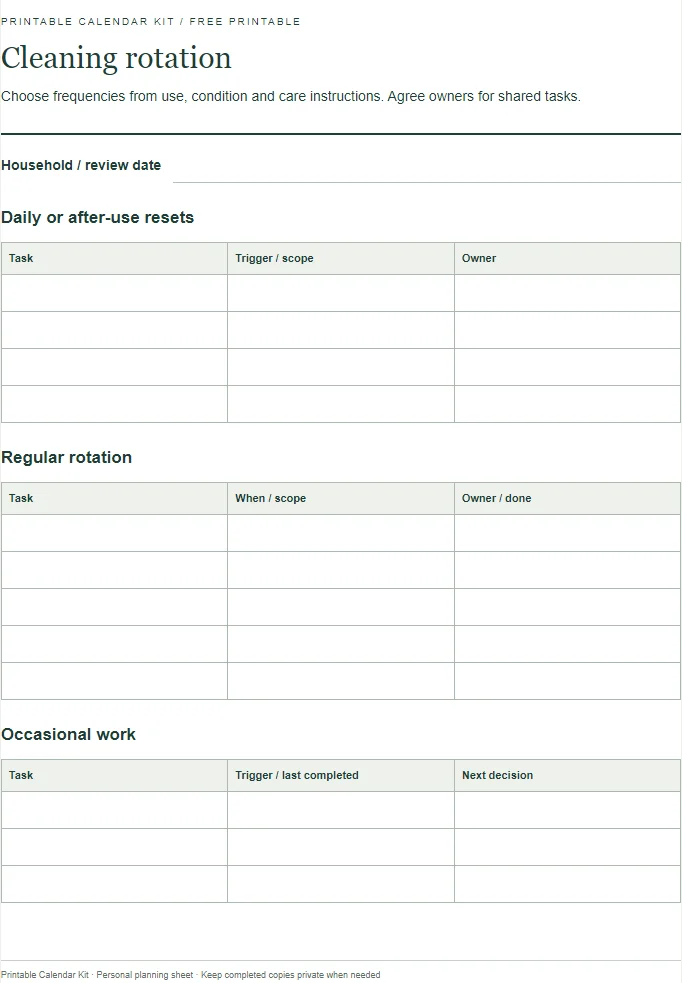
Open the printable daily, weekly and occasional cleaning checklists. The resource includes a blank rotation and two fictional examples. It organises tasks; it does not replace product labels, surface-care instructions or professional guidance for hazards such as significant mould or contaminated materials.
Separate daily resets from larger cleaning jobs
A reset puts a space back into a usable state. Examples include returning items to their places, dealing with dishes and clearing a work surface after use. A cleaning job removes dirt or addresses a particular maintenance need. The two can happen together, but separating them helps explain why a room can look tidy while still needing cleaning.
Choose a few resets connected to activities that already happen. Clearing a preparation area after cooking is tied to using the kitchen. Returning shared items at the end of an evening is tied to finishing that activity. A schedule based on actual use is easier to interpret than a rule to clean every surface every day.
Do not make the daily list an inventory of the entire home. Put larger jobs into weekly or occasional sections and give them a clear finish. “Clean bathroom” may be suitable as a heading, but the person doing it should know which fixtures and surfaces are included. Define the scope once so the same conversation does not recur every week.
Walk through the home and build the task list
List the spaces you actually use and the tasks each needs. For a room with a desk, note the floor, accessible surfaces and any equipment with its own care instructions. For a shared kitchen, note the work areas, appliances and storage areas separately. Avoid adding tasks for rooms or features you do not have simply because they appear on a downloaded checklist.
Look for tasks that depend on another action. A floor may need belongings picked up before it can be cleaned. A shelf may need objects moved before dust can be removed. Write those dependencies where they help estimate the job. Otherwise, a supposed ten-minute task can turn into an unplanned sorting session.
Separate cleaning from decluttering. Deciding what to keep can take much longer than returning items to known places. If a room has no clear storage arrangement, give that problem its own project slot. Repeatedly assigning “tidy room” will not resolve a missing decision about where the contents belong.
Choose frequencies from use and condition
The printable uses daily, weekly and occasional columns as organising options. They are not claims that a named task always belongs in one frequency. A frequently used entrance may need attention more often than a spare room. Pets, visitors, weather and the number of people using a space can change the workload.
Start with a reasonable trial rotation, then review whether each task is happening too late, too often or at the wrong time. If a floor repeatedly needs attention before its scheduled day, adjust the plan or add a small intervening task. If an occasional task consistently has nothing to do, lengthen the interval where appropriate to the item’s care requirements.
Some tasks are event-triggered rather than calendar-triggered: after a spill, after a particular activity or when an appliance’s instructions call for attention. Put the trigger in the schedule instead of forcing it into a weekly box. The phrase “after use, according to instructions” can be more accurate than an arbitrary weekday.
A small-home example
Imagine a one-bedroom home with one occupant who prefers short sessions. The daily reset covers dishes and returning items from the main living area. Monday has a brief bathroom session, Wednesday covers the main floors and Friday covers accessible surfaces. These are fictional allocations chosen to illustrate a rotation, not a required cleaning standard.
The occasional list includes checking the refrigerator shelves, cleaning an accessible window and reviewing storage that has become difficult to use. Only one occasional task is selected in a given week. This prevents the “monthly” heading from becoming a large hidden workload that suddenly appears on the final weekend.
The occupant estimates Monday’s bathroom task at twenty minutes after observing a previous session. If it regularly takes thirty, the schedule changes. The estimate should describe the job as it is, including gathering and putting away supplies. A plan that only counts active wiping time understates the time the person needs to set aside.
A larger shared-home example
An example rotation to adapt to the home
| Task group | Week 1 | Week 2 | Week 3 |
|---|---|---|---|
| Main bathroom | A | C | B |
| Shared floors | B | A | C |
| Kitchen surfaces and agreed appliance checks | C | B | A |
Weeks two and three illustrate the agreed rotation of the same three groups. Compare actual effort and each person’s constraints before adopting it.
Now imagine three adults sharing a home with two bathrooms and a busy kitchen. Each person is responsible for their own immediate mess, while shared tasks are assigned on a weekly rotation. Person A takes the main bathroom, Person B takes shared floors and Person C takes kitchen surfaces and the agreed appliance checks. The following week, they rotate the larger task groups.
Task groups should be compared by actual effort and constraints, not simply by the number of bullet points. One bathroom may take longer than several small surface tasks. If someone has limited availability or cannot do a particular physical task, agree a suitable arrangement rather than expecting identical assignments to produce a workable result.
Write the agreed finish and check-in time. “Shared floors completed by Sunday afternoon” allows flexibility while preserving a clear expectation. If a task needs doing before visitors arrive on Friday, say so explicitly. The schedule should not require housemates to infer an earlier deadline from an unrelated calendar entry.
Make supplies part of the plan
Keep a short list of supplies the agreed tasks require and note when something is running low. Assign replenishment as an action rather than hoping the next person notices. Store products according to their labels and keep the correct instructions available to anyone using them.
Do not use the checklist as a recipe for mixing products. Follow the individual product and surface instructions, including any ventilation, contact-time or rinsing requirements that apply. The CDC’s household cleaning guidance recommends suitable products used according to their labels and says not to mix products or chemicals. A planning page can organise the work; it cannot make incompatible products safe by placing them beside the same task.
If a surface is unfamiliar, check its care information before including a method in the household instructions. “Clean stone worktop” does not identify which material or finish is present. An appropriate method for one surface can be unsuitable for another. Keep the schedule focused on what must be done and where to find the correct method.
Deal with a missed week without doubling everything
If several tasks are missed, inspect the current condition and choose what needs attention first. Do not automatically add the entire missed list to the next week. Some jobs will now be more pressing; others may still be reasonable to leave until their next slot. The useful question is what the home needs now.
For a shared schedule, tell the other people when an agreed task cannot happen. Offer a new time or discuss a swap. A silent blank checkbox gives no indication whether the task was forgotten, intentionally delayed or completed without being marked. A short note keeps the record useful.
When the schedule repeatedly fails, reduce or redistribute the plan rather than redesigning the colours. You may need smaller task groups, fewer optional jobs or a different day. A realistic rotation that gets used is more valuable than a comprehensive checklist that nobody can fit into the week.
Review the rotation after a trial period
After using the schedule for a couple of ordinary weeks, compare estimates with actual time and look for recurring friction. Are supplies missing? Does one task require moving many objects? Is a shared room unavailable when its assigned person planned to clean it? Each observation points to a practical change.
Change one or two things and try again. You might keep supplies closer to the relevant area, clarify the task boundary or move an activity to a time when the room is free. Avoid interpreting every difficulty as a need for a more complicated system. Often the missing piece is a clear decision.
Keep the current rotation visible to its users, while storing any personal notes elsewhere. Date the sheet when you change assignments. If you print a replacement, remove the obsolete copy from the place where people check their tasks so there is one current version.
Print and customise the checklist
Choose A4 or Letter and portrait orientation. Preview the pages and print only the blank rotation or example you need. Write task names large enough to read at the point of use. If you need more detail about a method, keep that on a separate instruction sheet rather than squeezing it into a small checkbox row.
The blank page has fields for task, trigger or frequency, owner and completion. Use a date instead of a tick for occasional tasks when the last completion date affects the next decision. A weekly tick is enough for many routine jobs, but “done” without a date is less useful for an infrequent task.
Questions about a cleaning schedule
Does every room need a day?
No. You can group work by room, task type or the time available. A room-based approach can reduce switching, while a task-based approach can let you use the same supplies across several spaces. Choose the arrangement that matches the home and the people doing the work.
What belongs on the occasional list?
Tasks that are needed less often or when a particular condition appears. Record the relevant trigger or care instruction rather than assigning every item a monthly frequency. Select a manageable amount of occasional work alongside the regular rotation, then review what remains.
Can I keep supplies with the checklist?
Keep the checklist where it is easy to consult, but store products according to their labels and household needs. Write a missing supply as a separate shopping action instead of repeatedly copying an impossible cleaning task. Before the next session, confirm that the appropriate equipment is available. A completed check should describe work actually done, not merely a reminder that you intended to do it.