 Rob
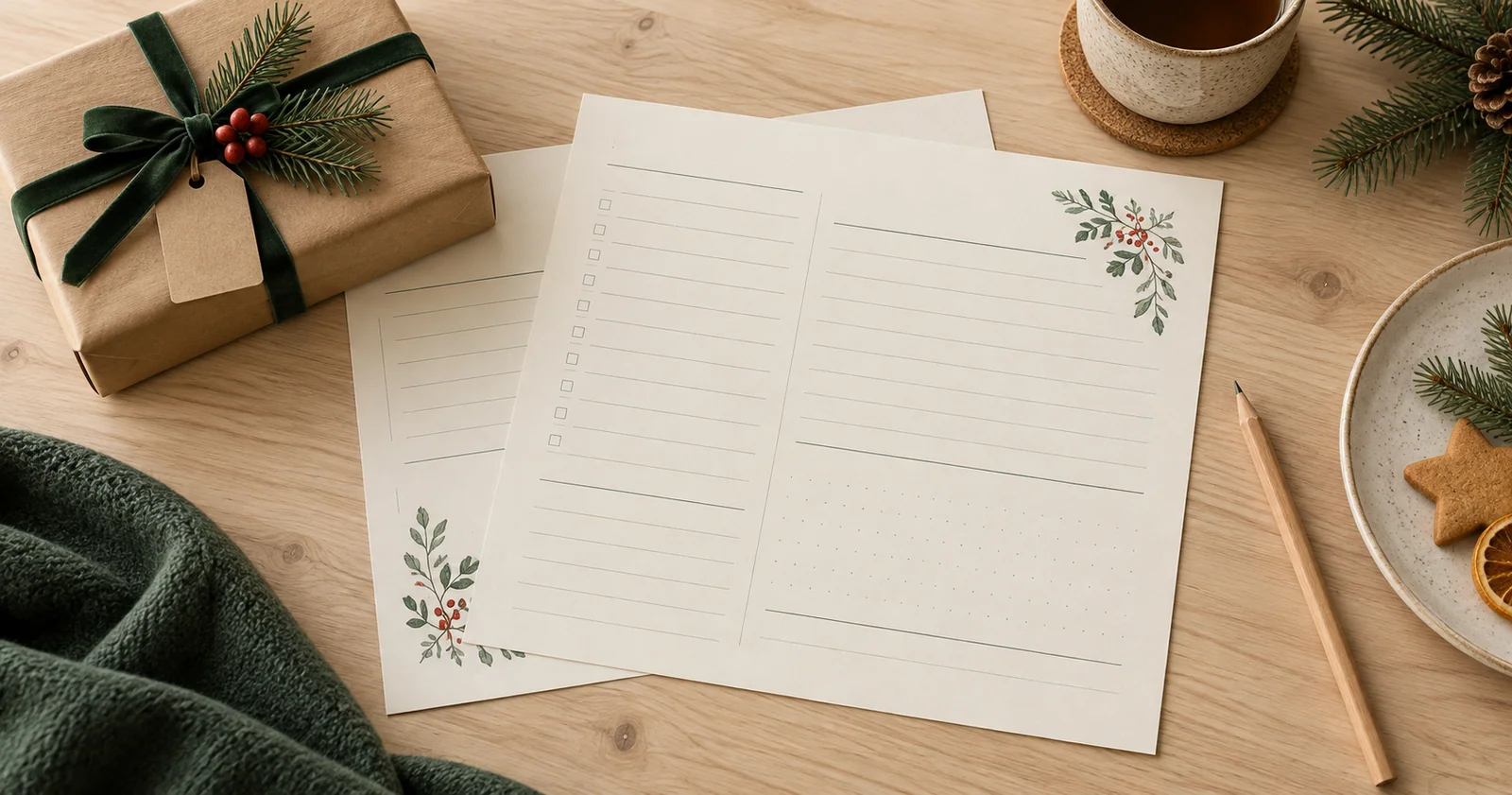
A Christmas planner works best when it separates decisions from errands. Deciding how many people are coming is different from buying food, and choosing a gift is different from remembering where you put it. This printable preparation pack gives those jobs separate places, then brings their deadlines together on a countdown page.
Open the printable Christmas preparation pack. It includes a gift list, meal plan, preparation checklist and countdown. Print the pages you need on A4 or US Letter. The pack is undated so you can use it next year without crossing out old dates. Add your own celebration date before working backwards.
Start with the Christmas you are actually planning
Before making a shopping list, write one sentence describing the event: “Lunch at home for six people on 25 December, with two guests staying overnight.” That sentence establishes several practical requirements. Six people need places to sit; overnight guests need sleeping arrangements; the host needs to know which jobs must be finished before people arrive. A different plan, such as visiting relatives for lunch, needs a different checklist.
Under the sentence, write three decisions that remain open. These might be the arrival time, who is bringing dessert and whether gifts will be exchanged. Give each decision an owner and a date for getting an answer. Avoid filling the preparation list with jobs that depend on unconfirmed plans. You can pencil them in, but mark the dependency so an uncertain guest count does not quietly become a firm shopping assumption.
Choose what is optional at this stage. Extra decorations, elaborate wrapping and several homemade dishes can all be enjoyable, but they also use time. Put optional ideas in their own small box. If the essentials expand, the optional box is the first place to reduce the plan. This makes changing your mind a normal part of preparation.
Use the gift list to track the whole process
A filled gift budget and status record
| Recipient | Idea | Chosen limit | Actual cost | Status / next action |
|---|---|---|---|---|
| Alex | Sketchbook | £15 | £12 | Arrived; wrap with flat gifts |
| Sam | Shared outing | Not yet chosen | Not booked | Confirm a date before booking |
The sketchbook is £3 below its chosen limit. Sam’s blank decision is not a zero-cost gift: agree the date and spending limit before recording a booking.
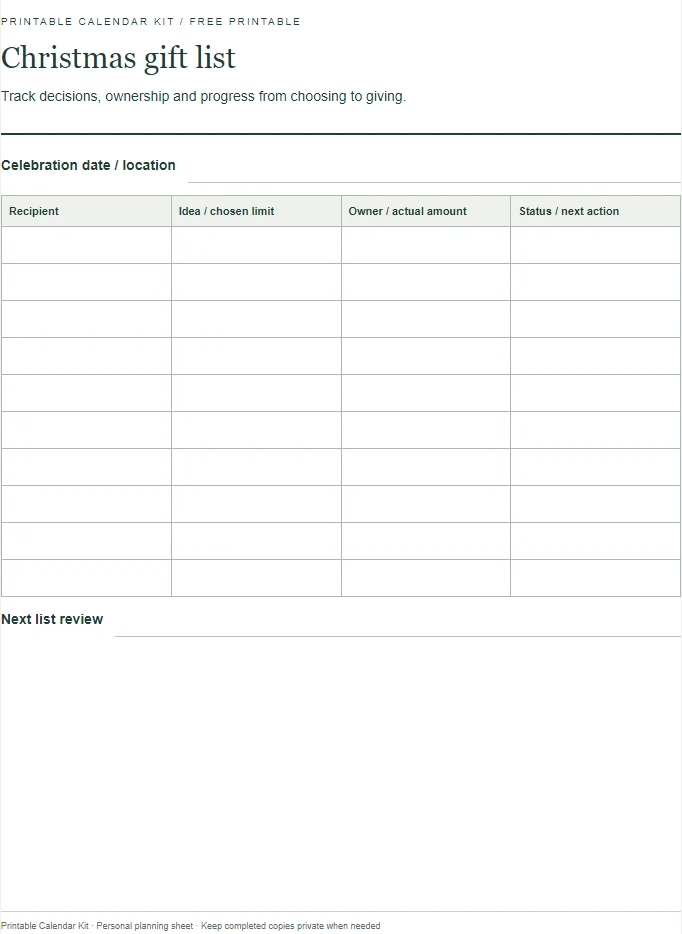
The gift page has room for the recipient, an idea, a spending limit you choose, the actual amount, and progress notes. A single “bought” tick rarely tells the whole story. An item may have been ordered but not delivered, delivered but not wrapped, or wrapped but left in the wrong cupboard. Use short status words such as “choose”, “ordered”, “arrived”, “wrapped” and “given”.
Here is a fictional example. For Alex, the idea is a sketchbook, the chosen limit is £15 and the purchase costs £12. The status says “arrived; wrap with flat gifts”. For Sam, the idea is a shared outing and the status says “confirm a date before booking”. The second line is useful even though nothing has been purchased. It identifies the next action instead of implying that every gift must be a parcel.
Keep delivery estimates and order references in a private note if you need them. The planner does not need passwords, payment details or full addresses. For things to be posted, check the actual carrier’s current service information and your destination rather than copying last year’s deadline. Write a personal sending date with some room for delays. The printable deliberately does not contain universal postal cut-offs.
If several people share the gift buying, name one owner for each item. “We need to buy this” can produce duplicate purchases or no purchase at all. A brief note such as “Lee choosing; Rob collecting on Saturday” is more actionable. Before another shopping trip, check the list together and update the status of items already in progress.
Build the meal plan around equipment and contributions
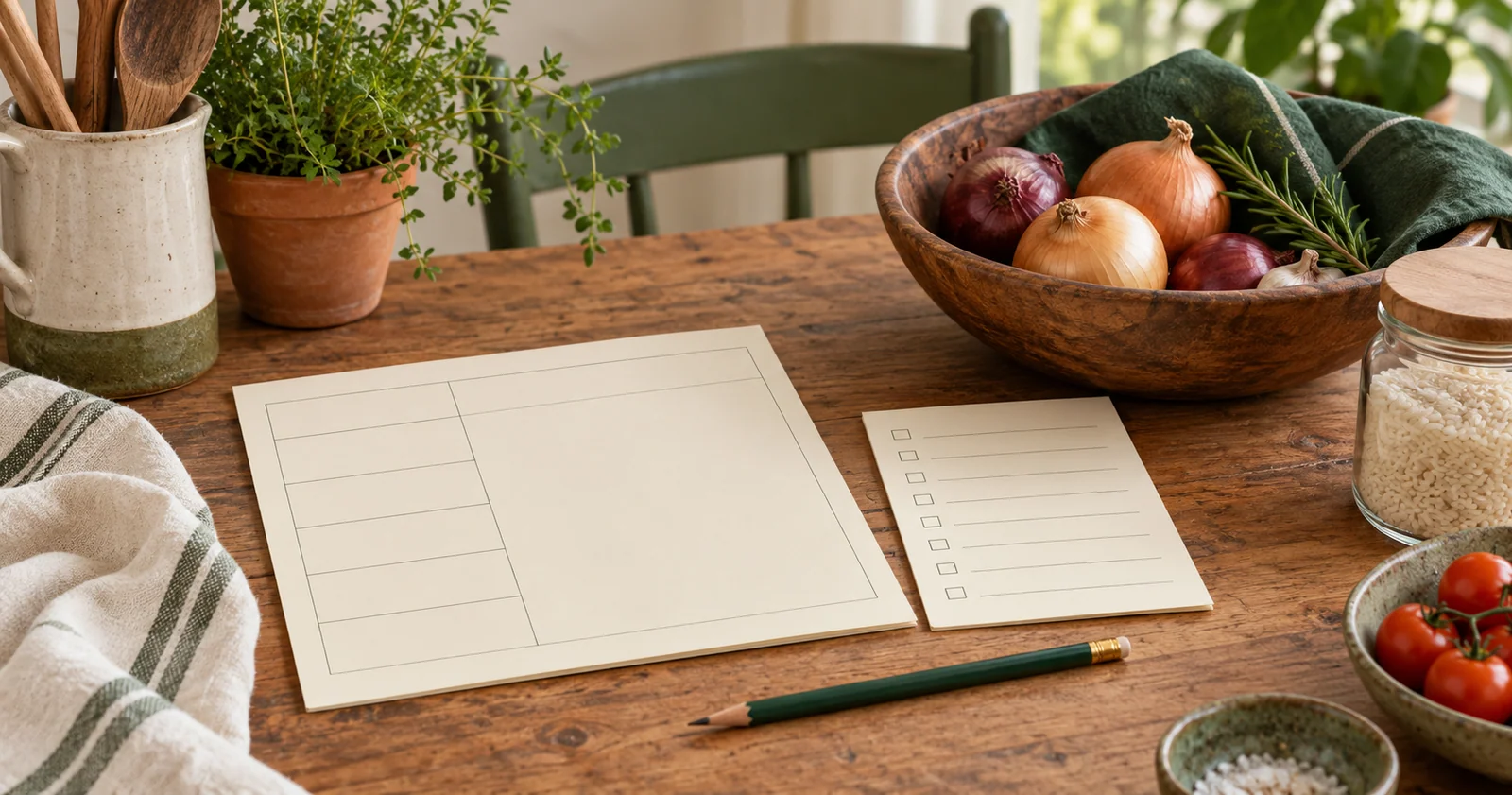
List the dishes or food arrangements first, then add who is responsible and what equipment is needed. You are planning the work here, not creating a prescribed menu. A potluck meal, a simple lunch and a larger cooked dinner can all use the same sheet. Ask guests directly about relevant food requirements rather than guessing from meals they have eaten before.
For a worked example, imagine lunch includes a main dish, two vegetable dishes, bread and a dessert brought by a guest. The meal page might show the host responsible for the main and vegetables, a housemate collecting bread, and the guest bringing dessert ready to serve. The useful detail is “ready to serve”: it avoids discovering at the last moment that the dessert also needs the only oven.
Add oven, hob, refrigerator and serving-space notes where they matter. Two recipes can each look manageable until both need the same shelf at different temperatures. Resolve that clash when choosing the menu. You might replace one dish, agree a contribution with a guest or follow a suitable make-ahead method from a reliable recipe. Do not invent storage or reheating times from the planner; use the food instructions that apply.
Turn the agreed menu into a shopping list only after checking what is already available. Separate shelf-stable purchases from items to collect nearer the meal. Put the collection date next to each group. A list of ingredients without a shopping day still leaves a scheduling job undone. Include practical supplies such as serving spoons or containers when the meal genuinely requires them.
Work backwards from the celebration date
An example countdown for a 25 December celebration
| Date | Decision or action | Evidence it is ready |
|---|---|---|
| 1 December | Agree guests, budget and contributions | One shared list |
| 10 December | Check gifts and deliveries | Ordered, received and wrapped are separate marks |
| 18 December | Confirm meal quantities and equipment | Contributors have agreed their items |
| 24 December | Pack items going to another household | Labels and transport checked |
The countdown page is a sequence of checkpoints, not a rule that preparation must begin a particular number of weeks ahead. Write your event date at the top and assign dates that fit your circumstances. If you have little time, shorten the list before compressing it. Removing an optional task is often more useful than moving six jobs onto the same evening.
For a 25 December gathering, an illustrative plan could put guest confirmation on 4 December, gift decisions on 8 December, an equipment check on 12 December, wrapping on 19 December and the final household preparation on 23 December. Those dates are examples chosen for this plan; they are not carrier deadlines, booking guarantees or requirements for celebrating Christmas.
Write an action beside every checkpoint. “Food” is too broad to complete. “Confirm dessert contribution with Jo” has a visible finish. “Decorations” could mean anything from finding a box to spending an afternoon putting things up. Decide which action you intend and estimate the space it needs in your week. Use the monthly calendar to place commitments that must happen on a specific date.
Leave one preparation window unassigned. It may be needed for a missed delivery, a changed guest arrangement or a task that took longer than expected. If nothing needs it, you have free time. A blank space is doing useful work when it protects the rest of the plan from small changes.
Give the final week a smaller checklist
By the last week, you should not need to reread every earlier idea. Transfer unfinished essentials to a short final list. Group them by place: errands outside the house, jobs in the kitchen, guest-space preparation and things to take when travelling. Location groups make it easier to combine compatible jobs without turning the entire day into one long task.
Distinguish preparing from cleaning everything. If guests are arriving for lunch, clear the spaces they will use and make the necessary equipment accessible. A full cupboard reorganisation may be a worthwhile project at another time, but adding it to the final checklist changes the scope. When a new task appears, ask whether it is required for the agreed gathering or simply something you have noticed.
For shared jobs, write who will do them and when you will check progress. “Set the table on the evening before” is clearer than “help with the house”. Make the plan visible to the people using it, while keeping gift details somewhere private if surprises matter. You can print the countdown separately from the gift page for this reason.
Print and adapt the pack
Open the pack, choose your printer’s A4 or Letter paper setting and inspect the preview. Each section starts on a new sheet. Turn off browser headers and footers if you do not want the web address and print date on the page. Print one section first if you are checking margins or handwriting space.
For a small celebration, use just the preparation checklist and write meal notes on its reverse. For a larger shared event, give each person their own copy of the relevant page and keep one agreed master countdown. When plans change, cross out the old decision clearly and date the replacement. Several partly updated copies are harder to trust than one visibly corrected sheet.
Questions about using a Christmas planner
What if I am starting late?
Begin with the event sentence, the essential meal or travel arrangements and any gifts you still choose to organise. Skip optional preparations until those decisions are settled. A shorter accurate plan is more useful than recreating a month of missed checkpoints. Give each remaining task an owner and an achievable next step.
Can I use this when Christmas is split across households?
Yes. Make a separate countdown for each gathering, with its date and location at the top. Keep one gift list if that is easier, adding the gathering where each item will be given. Check transport and packing as their own tasks so items do not remain at the wrong house.
What should I keep for next year?
Keep a short note of useful quantities, equipment that was missing and preparations you would happily skip. Record what actually happened rather than copying every unfinished idea forward. The aim is to reduce next year’s decisions, not to create an expanding list of obligations.